What’s Happening at Goshen Farm? A Community Guide to the Forest Mitigation Project
If you’ve noticed activity along the edges of the Goshen Farm property such as the presence of heavy equipment, orange fencing, workers clearing vegetation, and changes to the wooded areas along the school ball fields, you’re not alone in having questions. This article is designed to give you a clear, complete picture of what’s happening, why it’s happening, and what it means for the Farm and our community.
The Short Version
As part of the Cape St. Claire Fire Station Reconstruction Anne Arundel County’s Department of Public Works (DPW) has chosen Goshen Farm as the site to conduct their forest mitigation work in order to reduce the impact that the reconstruction is having on the critical area surrounding the construction site. The plan that DPW has developed is to remove the invasive plant species and replace them with native shrubs and trees on approximately 3.7 acres of Goshen Farm’s property. This will occur along the Cape St. Claire Elementary School ball fields and properties bordering Goshen Farm on Hilltop Drive.
The project is funded and managed entirely by Anne Arundel County DPW, not by the Goshen Farm Preservation Society. GFPS is a beneficiary of the work to remove invasive plant species and the replanting of native species. We know many of you have had questions and haven’t always had a place to find answers, that’s exactly why we created this page.
Why is This Happening Here?
The reconstruction of the Cape St. Claire Volunteer Fire Station on Cape St. Claire Road is causing ground disturbance and therefore requires mitigation under Maryland’s Critical Area laws to reduce the impact on the local environment.
Finding 5.5 acres of suitable land in Anne Arundel County can cause significant challenges. Typical mitigation efforts include planting trees on a tree bank in lower Anne Arundel County but DPW wanted to use land in the Broadneck area for these forest mitigation efforts to reduce impacts on the Magothy River and surrounding environment. A GFPS member connected DPW with Goshen Farm, and an innovative partnership was born. Through this partnership, DPW and Goshen Farmdocumented that the northern and eastern portions of Goshen Farm are heavily overrun with invasive species and partially within the Chesapeake Bay Critical Area, identifying this as an ideal mitigation site. The Chesapeake Bay Critical Area Commission reviewed and unanimously approved the plan in November 2024.
The result is a true win-win: the fire station gets its required forest mitigation, and Goshen Farm gets professional, county-funded invasive removal and native reforestation. This is work our volunteers have been doing by hand for over 14 years.
The State of the Eastern Forest
Goshen Farm stopped active farming in the mid-1960s, and invasive species moved in during the decades that followed. And we aren’t alone. This story plays out across the region wherever farmland gives way to woodland. While the wooded buffer along Goshen Farm’s eastern boundary appears healthy as it is green and growing, it is not a healthy forest ecosystem.
In some of the areas the plant growth is so densely overgrown that many animals and native plants can’t thrive. Grapevines two to four inches in diameter, porcelain berry, greenbrier, oriental bittersweet, multiflora rose, wisteria, trumpet vine, English ivy, and tree of heaven all choke out native vegetation in these areas. While there are some plants listed that are native to this area, they are still aggressive and are being removed.
These invasive and aggressive plants can impact native vegetation and animals in many ways. They prevent native trees from photosynthesizing, absorbing nutrients, invasives weigh them down causing large native trees to fall, and they provide poor habitat and food sources for birds and other species that call Maryland woodlands home. GFPS volunteers have been fighting these invasives for over 14 years and have successfully cleared approximately 5 acres of the Farm’s open areas. This project extends that work into the most heavily affected zones.
What the Forest Mitigation Project Involves
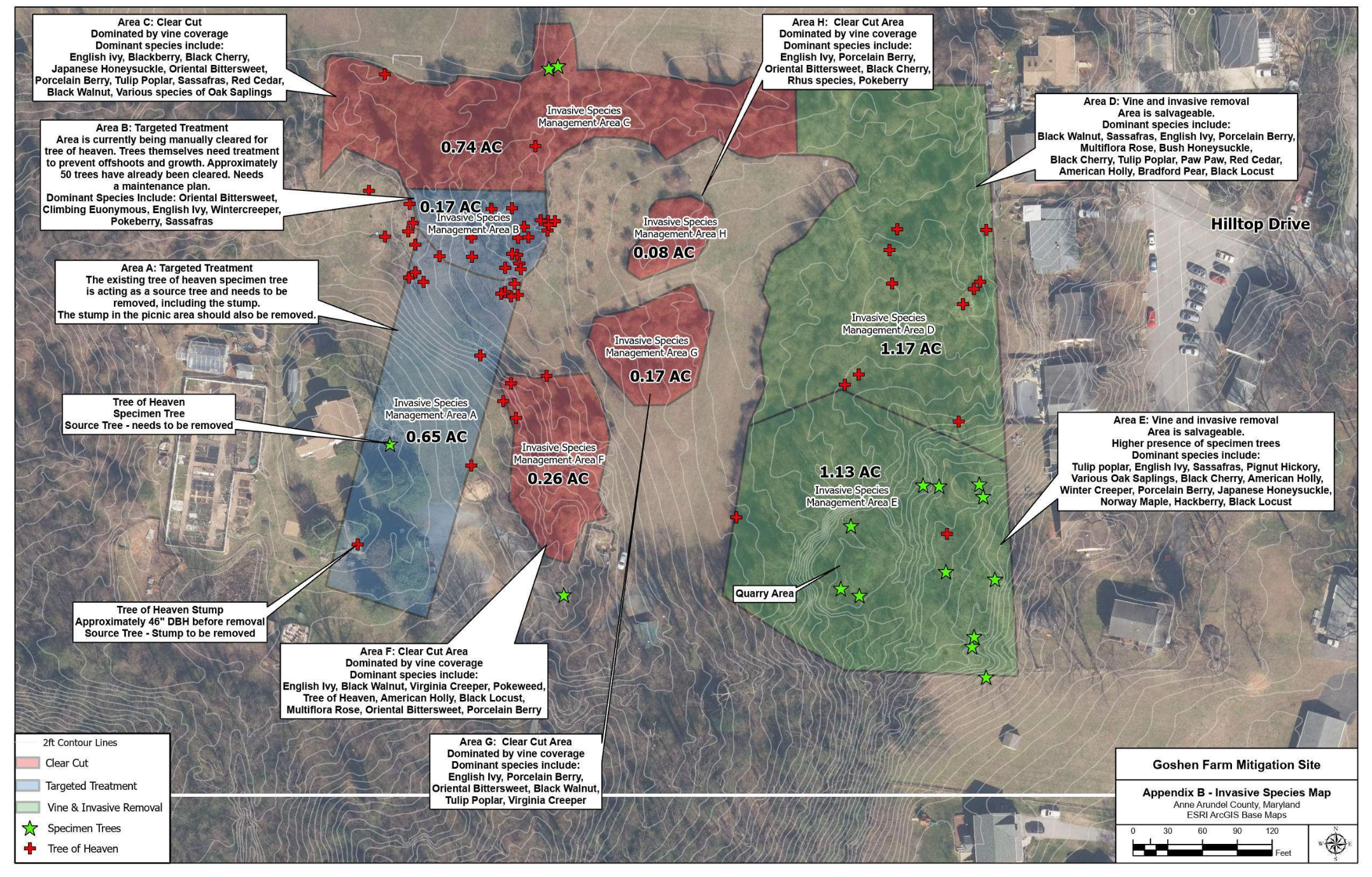
The project covers 8 designated Invasive Management Areas (A through H) across the northern and eastern portions of the property. Depending on the severity of infestation, each area receives one of three treatment approaches:
- Clear Cut with Full Replanting (Areas C, F, G, H): The most heavily infested areas, where invasive vines have completely overtaken the vegetation. Crews will clear, grub, and fully replant these areas with native species, treating any remaining invasive growth as needed.
- Targeted Invasive Removal with Selective Planting (Areas B, D, E): These areas carry moderate infestation levels, allowing crews to save existing native trees. Crews hand pull invasives, apply targeted treatment, and selectively replant with native species. Existing specimen trees and recently planted conifers stay.
- Targeted Treatment (Area A): This lower severity area sits near the historic Farm House. Crews target only invasive species here, leaving native trees intact.
The replanting plan features native Maryland trees, shrubs, and herbaceous plants, including species like tulip poplar, black walnut, sassafras, swamp rose, serviceberry, and witch hazel, chosen to enhance habitat for pollinators, birds, and other wildlife and to reflect the natural history of the site.
A 10-year Forest Conservation Easement covers all treated areas, legally protecting the land and holding DPW responsible for ongoing monitoring and invasive management for a decade after planting.
What About the Chemicals Being Used?
We understand that herbicide use is one of the biggest concerns in the community, and we want to be as transparent as possible.
The contractor, Childs Landscape Contractors, Inc., is working under a detailed management plan developed by KCI Technologies and approved by Anne Arundel County. Depending on the invasive species and the severity of infestation, one or more of the following herbicides may be used:
Vastlan (triclopyr), manufactured by CORTEVA Agriscience, has been confirmed as the primary herbicide in use. Triclopyr is a selective herbicide that targets woody invasive plants and is widely used in forest conservation work.
Glyphosate is also referenced in the approved forest mitigation plan for specific treatment scenarios, particularly for Tree of Heaven management. Glyphosate is one of the most studied herbicides in the world. The International Agency for Research on Cancer (IARC) classified it as “probably carcinogenic to humans” in 2015, while the U.S. EPA’s current position is that it is “not likely to be carcinogenic to humans” at typical exposure levels. We acknowledge this is an area of ongoing scientific discussion, and we believe the community deserves to know it may be part of this project.
The primary application method is “hack and squirt”, a highly targeted, hand-applied technique where applicators make small cuts directly into invasive stems and squirt herbicide into those cuts. This approach keeps chemical contact strictly within the treated plant, eliminating drift onto neighboring properties.
Certified pesticide applicators handle all herbicide work in strict accordance with manufacturer guidelines and all applicable state and local regulations. The project team will notify adjacent residents and Goshen Farm at least two weeks before any herbicide application by mailer, and workers will post signage on site during active work.
Important Notes
The US Fish and Wildlife Service reviewed the project and confirmed that no federally listed endangered or threatened species are present in the project area.
Visiting the farm during active work periods? Goshen Farm requires all dogs on leash at all times, and during active work periods, this matters more than ever. Keeping your dog on leash ensures they stay on established trails and away from any active work areas. Active treatment zones will be clearly marked with signage.
Wildlife Protections
From the start, the project team made wildlife protection a priority, putting specific measures in place:
- Fox Den: The project team identified an active red fox den between management areas early in the planning process and specifically modified the forest mitigation plan to protect it. The den appears explicitly on all project plans. Red fox kits typically begin venturing out of the den around 4-6 weeks after birth. However, the family continues to use the den as a home base through the summer and into fall. The project team has been actively monitoring the den throughout the season and is coordinating work timing accordingly. We recognize this is an important concern for the community, and we will share updates as the season progresses. For specific questions about timing and approach, please contact Brian Mui at DPW directly.
- Box Turtles: In late April 2026, the project team documented the presence of box turtles in portions of the work sites and immediately instructed the contractor to exercise extreme caution in those areas.
- Bees: GFPS has an apiary on the property. The use of Vastlan was reviewed and approved with the apiary in mind.
Project Timeline
The project runs through December 2026, with ongoing maintenance monitoring continuing for 10 years. Here is a general overview of the 2026 work schedule:
- Spring/April: Tree removal and invasive management begins in Areas A, D, and E
- Summer/June: Clear cutting in Areas C, F, G, and H; follow-up herbicide applications
- August–September: Hack and squirt herbicide applications; follow-up visits
- Fall 2026: Conservation seeding and replanting of native species across all areas
- Ongoing through 2036: Monitoring and treatment of any invasive regrowth
Work hours on site are generally 8:00 AM – 3:30 PM.
GFPS’s Role in Forest Mitigation
Goshen Farm Preservation Society is a partner and beneficiary of this project, not the project manager. Anne Arundel County DPW owns and manages all aspects of the work, including community outreach and resident communications.
Our role is to support the project, share information with our membership and the broader community, and help ensure that the Farm continues to be the community asset it has always been. We are grateful for this partnership and for the county’s investment in the long-term health of Goshen Farm.
Questions or Concerns?
For all project-related questions, visit their website or please contact the Anne Arundel County DPW project team directly:
Brian Mui, Assistant Project Manager, Anne Arundel County Department of Public Works
Be Part of the Story
There are several ways to connect with and support Goshen Farm:
Become a Member
Goshen Farm is a private, member-supported nonprofit. Your membership directly funds the preservation and care of the Farm. Annual memberships start at just $20 for individuals and $35 for families. Join here.
Volunteer
We rely on volunteers to help maintain and care for the farm year-round. Love getting your hands dirty? Join our volunteer crew for invasive removal, planting, and event support. Email volunteer@goshenfarm.org and let’s get to work.
Take It Home
Inspired by this project? You can make a difference in your own backyard. Maryland DNR has a great resource on native plants suited to our region.
Follow Along
Stay up to date on the project and everything happening at the Farm! Follow us on Facebook or sign up for our monthly email newsletter.
Share
Leave a Reply